HubSpot implementation and academic systems integration in higher education
This project was developed within a large higher education institution with nationwide presence, a broad academic offering, and multiple learning modalities (on-campus, online, and hybrid). Its operational scope spans the full student lifecycle—from prospective applicants to active students progressing through their academic journey.
From an institutional perspective, the environment operates under:
- Distributed organizational structures (university centers across different regions),
- Specific academic regulations,
- Regulated administrative processes,
- Pre-existing academic systems that concentrate critical student data.
In organizations of this nature, technology platforms must do more than scale in volume. They must respect academic rules, support non-linear processes, and accommodate responsibilities distributed across multiple institutional areas.
The most constrained process was the integrated management of applicants and students, particularly across admission, contact, follow-up, and post-enrollment support stages.
Previous operating model
Before the intervention:
- Inquiries entered through multiple channels,
- Information was fragmented across teams and tools,
- Personalized follow-up relied heavily on manual actions,
- The student’s real academic status was not always visible within relationship management systems.
This model worked under low-volume conditions but failed to scale when:
- The number of programs and modalities increased,
- Geographic distribution expanded,
- Multiple areas intervened in the same admission process,
- Full lifecycle traceability became a requirement.
Real-World constraints
The challenge could not be solved by simply “adding a CRM” due to:
- The academic system (SIS) being the primary source of truth,
- Admission flows that were non-linear and not centralized,
- Processes requiring segmentation by program, modality, and region,
- The need for automations governed by specific academic rules.
HubSpot as a relational layer integrated with the academic system (SIS)
In this project, Bitlogic implemented HubSpot as a central relationship management platform for higher education, designed to organize, automate, and centralize processes related to applicants and active students—without replacing the institutional academic system.
HubSpot was positioned as a relational and operational layer, while the SIS remained the authoritative source for academic, regulatory, and administrative data. This separation enabled process scalability without duplicating academic logic or compromising institutional compliance.
Academic data modeling with custom objects
The implementation leveraged HubSpot’s object-oriented data model. In addition to native objects, Bitlogic designed and deployed custom objects aligned with the university domain, including:
- Academic records,
- University service centers,
- Intermediate entities to represent relationships between students, programs, and campuses.
This approach allowed the CRM to reflect the institution’s real structure, avoiding oversimplifications that often lead to operational inconsistencies in EdTech projects.
Educational process automation with workflows and custom actions
HubSpot workflows were configured as process orchestration tools—not as repositories for academic rules. They were used to:
- Coordinate intermediate admission states,
- Execute operational actions on contacts and related objects,
- Trigger integrations with external systems.
When business logic exceeded standard workflow capabilities, custom actions were developed to:
- Process education-specific rules,
- Interact with external APIs,
- Maintain consistency between HubSpot and the academic system.
HubSpot–SIS integration
A key technical decision was implementing a bidirectional integration between HubSpot and the university’s academic system. This enabled synchronization of critical data such as:
- Program and modality,
- Academic status,
- Approved courses,
- Administrative standing.
These data points powered contextual automations and operational views, without transferring normative logic into the CRM.
Interface extensions and student support enablement
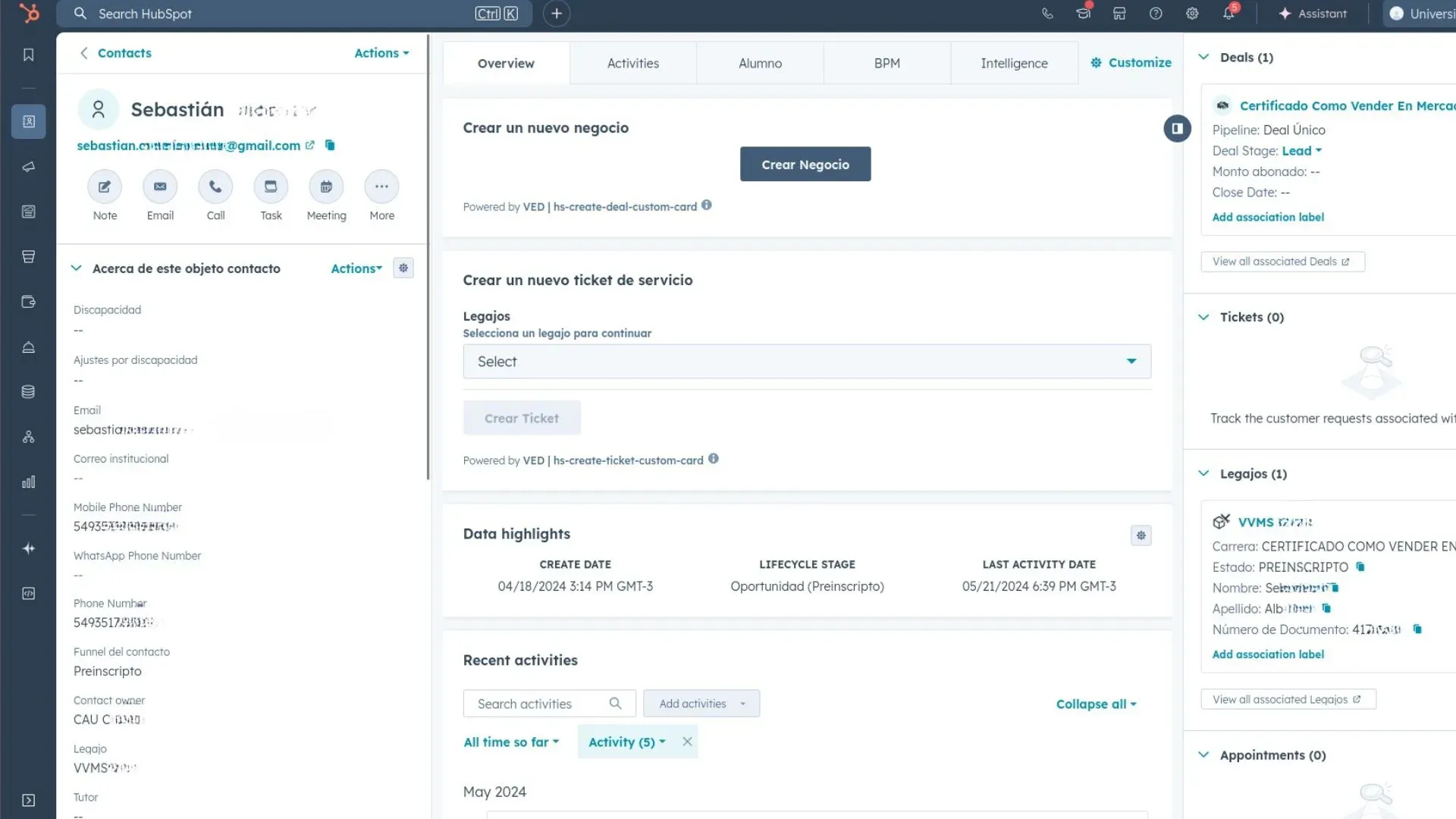
To improve institutional team experience, Bitlogic developed custom cards within HubSpot, displaying relevant academic information directly in contact and object views. This significantly reduced reliance on multiple systems for day-to-day operations.
Additionally, ticketing functionality was implemented to centralize student requests—such as certificates or administrative issues—ensuring traceability and consistent response times.
Core components
- HubSpot CRM as the relationship management system,
- Academic system (SIS) as the source of academic truth,
- Integration services for complex logic,
- External messaging and communication providers.
Data model
The solution used:
- Native objects: contacts, deals, tickets,
- Custom objects: academic records, university centers, academic entities.
This modeling approach represented education-specific concepts without forcing generic structures.
Information flows
- An applicant submits a form,
- A contact is created or reactivated,
- A primary deal is generated based on academic interest,
- Automated data cleaning and normalization processes run,
- Secondary deals are created according to institutional rules,
- Academic status is synchronized from the SIS when applicable.
Automations
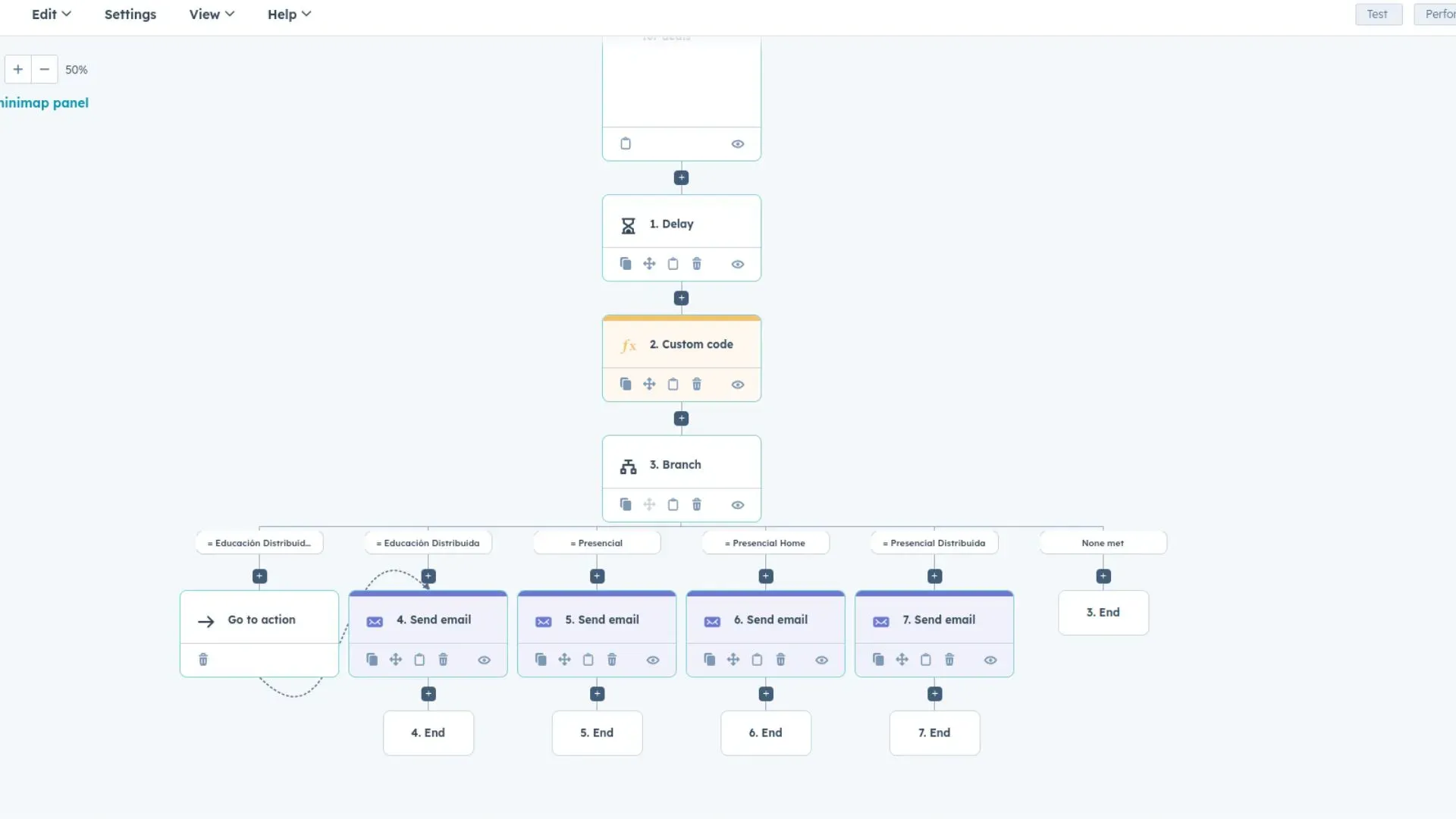
Workflows were used for:
- Automatic entity creation,
- Data normalization,
- Contact reactivation,
- Triggering external integrations.
When standard logic was insufficient, custom actions were implemented.
Integrations
- SIS synchronization for academic data,
- Interaction logging from bots and advisors,
- Routing qualified leads to contact queues,
- Triggering messaging campaigns from academic workflows.
Measurable Outcomes
Results were observed primarily at an operational level:
- Centralized information
Unified applicant and student data within a single relational system.
- Reduced manual processes
Automated creation of contacts and deals, with standardized data intake.
- Improved traceability
End-to-end visibility of the applicant journey and consolidated interaction history.
- Enhanced analytical capabilities
Clear funnel visualization, dropout point identification, and correlation between academic interest and conversion.
Key Learnings for Similar EdTech Projects
What We Would Do Again
- Use a CRM as relational infrastructure—not just a sales tool,
- Clearly separate:
- academic source of truth (SIS),
- relational layer (CRM),
- integration logic,
- Explicitly model academic entities.
What depends on institutional context
- Admission process complexity,
- Degree of academic decentralization,
- Maturity of the existing academic system.
Considering a CRM architecture for higher education?
If your institution needs to integrate HubSpot with an existing academic system, automate complex admission processes, or design an EdTech architecture that respects real academic rules, this case can serve as a technical reference.
We work on relational platform implementations and academic integrations for higher education institutions, with a focus on scalability, traceability, and institutional consistency.
Let’s analyze your academic context and design the right architecture together.
We’re building the future of education. Let’s talk ;)