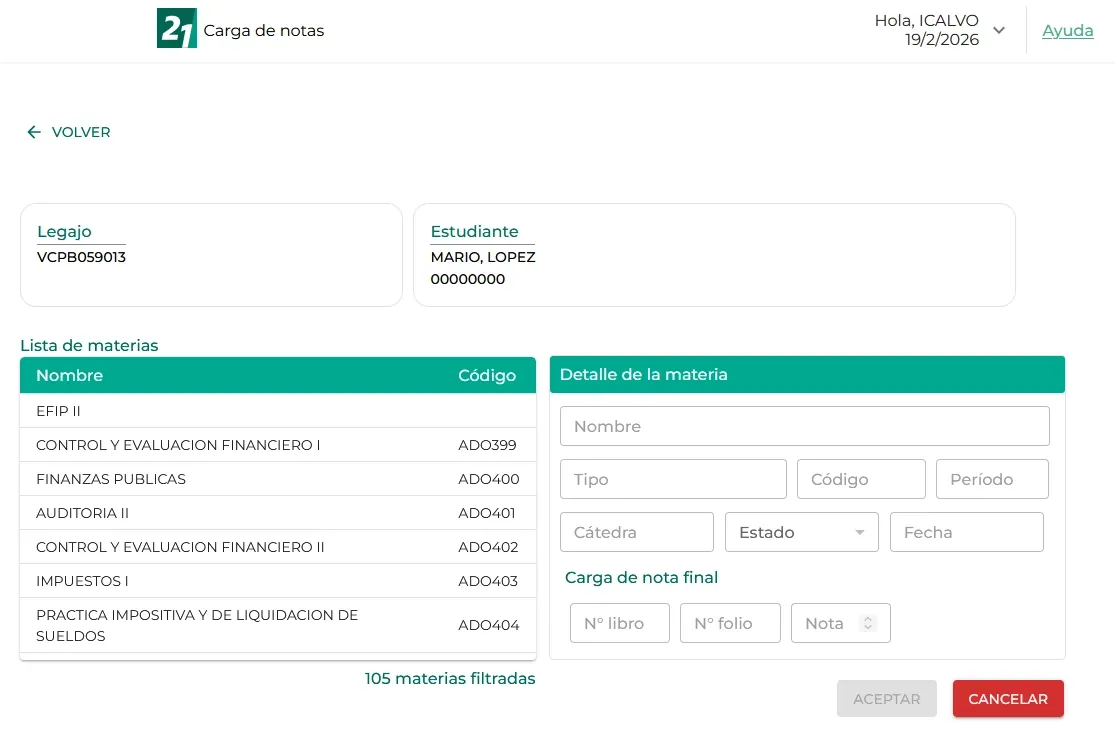
Grade entry at a university
This project was developed for a private university in Argentina operating under strict regulatory frameworks and a hybrid academic structure. The institution already had digital tools in place, but after a period of strong institutional growth, a common higher education issue emerged: systems existed, yet interoperability between them was inconsistent.
The challenge was not to introduce new technology, but to reorganize an ecosystem that had evolved in layers, without a unifying architectural vision.
Academic operations depended on:
- Multiple legacy systems
- Manual validations
- Processes not designed to scale
- Distributed traceability across different platforms
As student volume increased, the model began to fragment.
Design and architectural decisions: improving without disrupting academic operations
The core of the project was not a new feature, but a software architectural decision.
A service-oriented model was chosen, enabling the integration of existing systems without fully replacing them. A complete platform overhaul would have implied high institutional and operational risk.
The infrastructure adopted a serverless approach for critical processing components. This responded to the real academic usage pattern: intense peaks during evaluation periods and lower demand throughout the rest of the cycle. Automatic scalability allowed the system to adapt to this dynamic without overprovisioning resources.
At the data layer, a centralized validation system and structured traceability model were defined. Academic rules were no longer distributed across platforms; instead, they were managed from a single logical core.
The integration strategy was progressive:
- Intermediary APIs to connect legacy systems
- Controlled data synchronization
- Decoupling between user experience and backend
The objective was to improve the architecture without interrupting academic operations.
How does the new grade submission platform work?
The solution included four main components:
- A centralized grade management module
- A configurable academic rules engine
- An integration layer connecting existing systems
- An administrative dashboard for monitoring and auditing
The operational workflow was clearly structured:
The instructor submits an assessment grade
The system validates it against academic rules
The information is synchronized with the institutional system
Each event is logged for auditing purposes
The architecture preserved operational stability while improving systemic coherence — maintaining day-to-day continuity as the overall system became more consistent and robust.

Stronger academic governance: integrity, rigor, and transparency in the educational mission
The changes we implemented were not superficial improvements, but a structural transformation with direct impact on daily operations.
Manual interventions in academic validations were reduced, and inconsistencies between systems decreased. During peak demand periods, processing became more stable and predictable.
The university was able to scale its operations without increasing administrative workload.
More than speed, the real outcome was governance: greater control over rules, processes, and traceability.
Key lessons for universities seeking to scale
This project offers insights applicable to other higher education institutions.
- Process architecture must be defined before selecting specific technologies. Adding tools without redesigning the system only amplifies fragmentation.
- Legacy systems do not always need to be replaced. In many cases, a progressive integration strategy reduces risk and accelerates results.
- Centralizing academic rules is critical to ensuring consistency, regulatory compliance, and scalability.
- Early involvement of administrative teams in validation design improves adoption and reduces later adjustments.
A structural decision, not just a technological one
This project aligns with our approach to EdTech architecture and academic process digitalization. It reinforces a core principle in higher education: the issue is rarely a lack of technology, but rather the need to apply technological intelligence in service of the educational mission.
When technology stops operating in fragmented layers and becomes integrated into the core of the academic system, the impact is not only operational. It is institutional.
We are designing the future of education. Let’s talk.