When students use aprendiz, they move forward. The data proves it.
There is a reality shared by all educational institutions, regardless of whether they operate in a face-to-face, hybrid, or online format: learning does not happen only in the classroom or during scheduled academic hours.
Questions arise while studying, while trying to complete an assignment, while preparing for an assessment, or when facing a concept that is not yet fully understood.
Often, this happens late at night, during weekends, or at times when an immediate response is simply not possible.
For Social Learning, an educational group operating higher education institutions across Argentina, Chile, and Mexico, this represented a very real challenge. With thousands of students and a flexible learning model, providing timely support became a strategic priority.
This reality raises a fundamental question:
How can institutions support students during the moments when learning happens independently, without losing the pedagogical guidance and human connection provided by teachers, tutors, and academic coaches?
A common challenge in education: questions cannot wait
Social Learning's academic teams identified a recurring situation. When students encountered difficulties while studying, they would typically submit a question through the available channels and wait for a response.
However, in many cases, that response could not arrive immediately.
In subjects with progressive learning paths, such as Programming Logic, Mathematics, or Social Sciences, an unresolved question can quickly become a barrier to continued progress.
The challenge was not the quality of the content, nor the commitment of the academic teams.
The challenge was availability.
How can institutions support thousands of students across different schedules, contexts, and countries without compromising the quality of the educational experience?
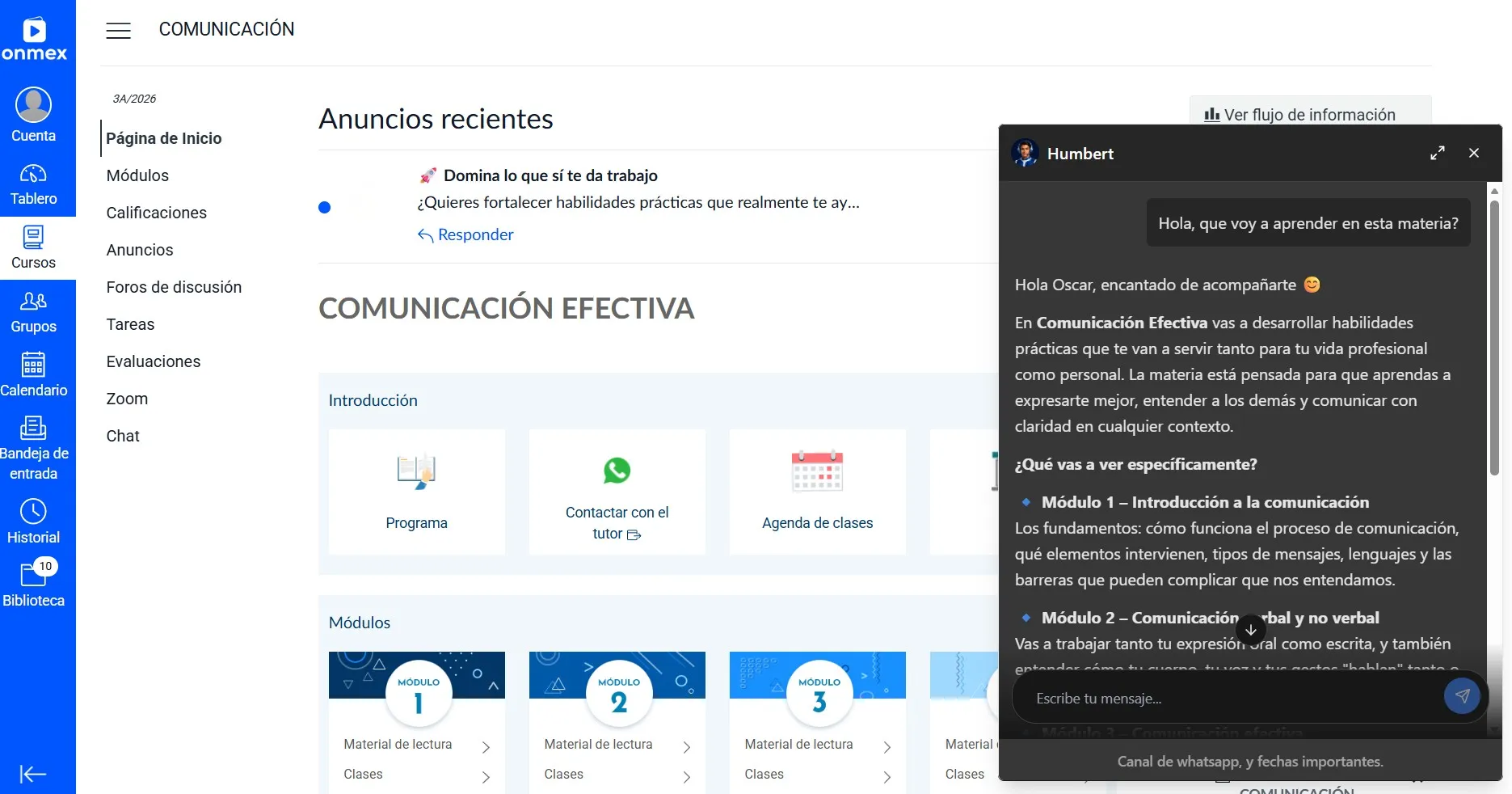
The decision: implementing a 24/7 academic assistant
To address this challenge, Social Learning implemented aprendiz, the AI-powered academic assistant developed by Bitlogic.
From the beginning, the objective was clear:
To enhance the work of teachers, tutors, and academic coaches, not replace it.
Aprendiz was designed to support students whenever questions arise, providing immediate guidance within the learning environment.
Its role is not to complete assessments or replace educators. Its role is to help students continue making progress.
To achieve this, aprendiz integrates directly into the institution's LMS, Canvas, making academic support available within the student's existing learning experience, without requiring additional applications or access processes.
A specialized tutor for every subject
One of the most important aspects of the implementation was avoiding the generic chatbot approach.
Each tutor is configured specifically for a particular subject.
This means the assistant understands:
- Course content
- Learning objectives
- Assigned bibliography
- Teaching methodology
- Academic activities and coursework
Thanks to this approach, responses remain aligned with the educational context of each course and help students understand concepts relevant to their learning process.
Aprendiz is designed to guide students through questions, examples, and explanations, promoting understanding and learning through pedagogical scaffolding.
What happened when students started using aprendiz
The implementation reached students from Teclab (Argentina), IPP (Chile), and Onmex (Mexico), generating thousands of interactions during the analyzed period.
The most important finding was not how often students used the tool.
It was what happened afterward.
By analyzing aprendiz interactions and comparing them with academic records, Teclab's team identified a compelling result:
8 out of 10 students showed academic progress after interacting with aprendiz. (1)
Students demonstrated improvement in assignments, coursework, and assessments within the same subject. More than 71% of students successfully completed the analyzed course requirements.
The data shows a clear relationship between academic support and student progress.
Source: Academic progress report conducted by the institution.
Students do not use AI to avoid learning
One of the most common concerns about artificial intelligence in education is that students may use it to obtain quick answers without understanding the underlying concepts.
The data observed by Social Learning tells a different story.
More than 90% of recorded interactions were academic questions related to course content, assignments, or concepts.
Students did not turn to aprendiz to avoid learning.
They turned to aprendiz to continue learning.
When they encountered difficulties, they sought guidance, explanations, and support to better understand what was preventing them from moving forward.
According to Jessica Longo, Academic Coordinator at Social Learning:
"The implementation of aprendiz enabled immediate support that was available at all times. It improved the student experience by providing answers exactly when students needed them, especially outside traditional support hours, while complementing the work of tutors and coaches."
More support for students, more insight for institutions
The impact of aprendiz extends beyond the student experience.
It enables academic teams to gain valuable insights into how, when, and where students need additional support.
Through interaction data, institutions can:
- Identify the most frequently discussed topics
- Detect recurring difficulties
- Understand critical moments in the academic journey
- Adjust support strategies
- Improve communication processes with students
Key learnings about artificial intelligence and student support
This experience offers valuable lessons for any educational institution considering the adoption of artificial intelligence.
AI works best when it complements educators
The most effective tools do not replace people.
They expand the support capacity of academic teams and enable institutions to reach students in moments that were previously difficult to address.
Learning does not follow fixed schedules
Learning happens at different times and often outside traditional support windows.
Being present during those moments can significantly improve the student experience.
Data is also part of student support
Every interaction provides valuable information for academic and administrative teams, helping them better understand student needs and make more informed decisions.
According to Jessica Longo:
"Having access to this information allowed us to more accurately identify recurring difficulties and the topics that generated the highest number of questions. It provided visibility to continue making data-driven decisions, adjust resources and support strategies, improve communication, and focus our efforts on interventions that deliver greater value to students."
The future of academic support
Social Learning's experience demonstrates that artificial intelligence can play an important role in education when it is designed to solve real problems.
Every interaction generates valuable information for the institution.
Through its Learning Observatory, academic and administrative teams can identify which topics generate the most questions, where learning bottlenecks occur, when students most frequently need support, and which strategies can improve the student experience.
aprendiz not only helps students move forward.
It also helps institutions better understand how students learn and make evidence-based decisions.
The results show that when support is available at the right moment and is complemented by actionable insights for academic teams, students have greater opportunities to succeed.
Because when students use aprendiz, they move forward.
And the data proves it.
Let's talk ☕️


